
FluxLab Conducts 'Fast, Accurate, and Targeted' Field Measurement Campaign to Characterize Methane Emissions from Canadian Landfills
In 2022, the FluxLab research team launched a multi-month national field measurement campaign of methane emissions from landfills, covering 42 landfills and combining vehicle-based and aerial monitoring methods. The results showed that measured emissions were generally lower than model predictions, particularly in cold and arid climate zones. This research provided key data support for Canada's first federal landfill methane regulations and revealed the limitations of current IPCC models in specific climate types.
For a long time, major countries have primarily relied on model tools to estimate greenhouse gas emissions released from landfills. However, this situation is changing as field monitoring technology becomes more mature and emission reduction efforts intensify.
Several research teams have begun collecting field emission data, including FluxLab, a research group at St. Francis Xavier University in Antigonish, Nova Scotia. Similar to other landfill monitoring organizations, FluxLab initially honed its site monitoring capabilities at oil and gas facilities before shifting its focus to landfills.
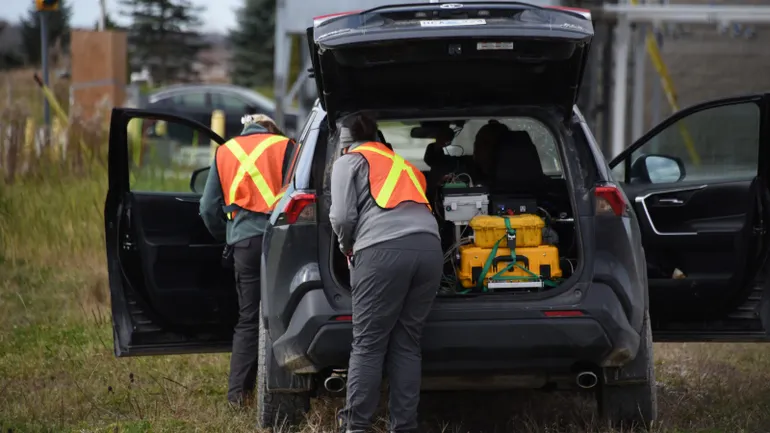
In 2022, the lab installed multiple instruments into two Toyota RAV4s and sent teams out in separate directions to conduct a multi-month nationwide landfill measurement tour. At the same time, they also deployed aircraft to conduct simultaneous verification at some of these sites. The data collected informed the development of Canada's firstfederal landfill methane regulations, which were finalized last year.
In June of this year, FluxLab published apeer-reviewed studybased on these measurement campaigns. In a survey covering 42 landfills, the research team found that measured emissions were generally lower than predicted levels, especially at sites in cold, arid environments. The researchers encountered numerous challenges along the way, including results that contradicted existing models, and even an incident where a vehicle was nearly stolen.
Dave Risk, scientific lead at FluxLab, told Waste Dive that these findings reveal the influence of regional climate on methane generation at landfills. The study also validated emerging understanding about landfill emissions, including the importance of gas collection at the working face, as well as identifying opportunities for improving gas collection systems at small municipal landfills.
This interview has been edited for clarity and brevity.
Waste Dive: Why is it so important to accurately understand methane generation at landfills across Canada?
Dave Risk:It stems from Canada's methane reduction plan. We had never before regulated any emissions from landfills at the national level. Canada has the will to regulate because the sector is tied to significant emission reduction targets. That's the starting point.
When you want to regulate, the question becomes: How accurate are our current estimates? We really want to know whether the starting point is reliable when considering regulation. For example, is our dataset good enough, or are we starting from incorrect assumptions? That was the motivation for conducting this research, which we carried out in collaboration with the federal government.
Environment and Climate Change Canada estimates that using default parameters to calculate methane emissions carries an uncertainty of plus or minus 76%. Why is the uncertainty range so large?
Canada is clearly a country with extreme climates and significant seasonal variations. The default parameters used to generate national inventory estimates are generic ones developed by the Intergovernmental Panel on Climate Change (IPCC). They represent a limited range of climate types and may not cover the subarctic climates we encounter.
Because provinces are the regulators of landfills, we cannot report data to the federal government in a very streamlined way. The federal government's data mainly comes from voluntary surveys of landfill operators. Since it's voluntary, not all operators submit information, and the quality of information can vary because it isn't reported in a regulatory context.
Furthermore, the federal government doesn't necessarily have a clear picture of the age of landfills in some parts of the country, or the amount of waste they've received over time. Our estimates for some landfills are more accurate than for others, which is another source of uncertainty.
There's uncertainty inherent in the models themselves, combined with uncertainty in the data inputs, and together that produces considerable uncertainty.
The data from your study was used to help develop the Canadian federal government's regulatory approach to landfills. Can you talk about your communication with regulators and the questions they wanted you to help answer?
I think the main questions centered on the starting point. Regulators were very concerned about: Are the national-level estimates accurate, or are the provincial numbers reasonable?
At the site level, regulators also have needs. Landfill operators must use specific methods to report their emissions and conduct self-assessments. Canada hasn't had such requirements before. If we're going to suggest that industry use a specific modeling tool for self-assessment, we should also evaluate whether that tool performs well—not just at the national or provincial level, but also at the site level, because we need to know whether reduction targets are reasonable and how to set them.
Your research method sounds almost like a landfill methane measurement caravan tour. Can you describe what it was like collecting these measurements?
The initial project came together very quickly, building on our previous work with the federal government in the oil and gas sector. They contacted us, expressing interest in understanding emission levels at landfills.
Within four months, we were on the road. Two measurement vehicles started from the east and west sides of Canada respectively, heading toward each other, visiting two landfills per day, sometimes one per day, with travel days in between. Our initial plan targeted 120 sites.
At the same time, we also deployed aircraft. We equipped the planes with the full suite of mass balance equipment used in scientific aviation. In addition to the truck measurements, the aircraft covered some sites in Ontario, Quebec, and Alberta, sometimes visiting the same site at similar times.
All of this work was actually completed in a very short period. It was a fast, focused, and exciting measurement campaign.

We spent roughly five months on the road, with breaks in between. Field teams needed to rotate, with personnel cycling in and out of the two measurement vehicles or the aircraft.
We submitted all our reports to Environment and Climate Change Canada within about nine months. It was a very large-scale research effort.
This type of measurement work is mentally demanding. It's like being a truck driver, but you also have to keep thinking at all times.
All sorts of unexpected things happen during large field campaigns. Once, our measurement vehicle was stolen in Montreal, packed full of instruments. Of course, with all sorts of equipment mounted on the roof, the thieves couldn't strip it in time, so they abandoned the vehicle, and it was recovered later that day.
Carbon Mapper was also using aerial measurements around the same time to identify fugitive methane emissions at landfills. How should we view your measurements and data in relation to other attempts at emission calculations?
I think what we're seeing is very similar, and once we started talking with Carbon Mapper, we felt very reassured.
This suggests there are some important fundamental issues. For example, the working face is more important than we previously thought for most landfills. I think that's a common theme across our different studies. We do see emissions from gas collection systems. Ironically, at sites that are producing RNG (renewable natural gas), emissions are sometimes even higher, because they've optimized landfill conditions to generate gas, but this creates problems, or the gas isn't being adequately collected.
I think some of the things we delved into more deeply in this study, the Carbon Mapper team may not have done as much. We focused more on climate types, because federal inventory models will continue to use IPCC models. That's an area where we were able to provide new insights.
We did find that in very arid regions, especially cold, arid landfills, methane generation potential is extremely low. Climate effects matter. For many climate types, the IPCC model works well, but it definitely needs correction for central Canada. That's one of the main differences in our study.
We also looked at landfills of different sizes. Canada has many very small landfills that typically aren't targets in U.S. studies, but they were a focus for us. We found that some very small sites have very low collection efficiency, which is likely mainly attributable to the size of the working face relative to the waste pile and collection area. Because they're small, the active working face is relatively larger.
Your study found that emission rates were lower than current IPCC model predictions. Why is that?
The landfills we measured differed greatly from what was recorded in the database, so we were skeptical of our own measurements—whether from aircraft or trucks—mainly because they didn't match the predictions generated by the inventory models. Over the following year, we did a lot of self-reflection, asking ourselves: 'Is there a problem with our measurements, or is the problem with the quality of the input data and the models themselves?'
After some time, we ultimately concluded that the estimates were indeed problematic, and our measurements were quite accurate. We conducted controlled release tests and also validated our instruments. This boosted our confidence. The fact that aircraft and truck measurements agreed with each other further increased our confidence.
This type of landfill survey hasn't been conducted in many countries yet. When you find that measurements don't align very well with predictions at the site level, you start scratching your head, because there are so many unknowns. It took us a while to truly build confidence and eventually publish the paper.
For most of Canada, emission levels were broadly in line with expectations. But we did find that the IPCC model performs poorly in arid climate types. The deviations from expected values mainly appeared in those very arid regions. That's where the model uses incorrect decay constants for local conditions.
Additionally, about 95% of Canada's population already has organic waste diversion programs. I worry that the IPCC model sometimes treats organic matter too generically and doesn't fully account for this. This could also be a variable explaining why in most places our emissions weren't higher than IPCC predictions.
Your study also noted that most measurements were taken during the summer. Do you think you would get similar results if you measured at other times of the year?
In Canada, some regions have very cold winters, and surface microbial activity essentially stops during the winter. We lose the potential for winter methane oxidation, so we can see emissions rise somewhat in the winter.
The underestimation we observed was mainly driven by some landfills in the west. I think if you looked at the full year and all of Canada, the underestimation would be smaller. We're currently working with Environment and Climate Change Canada on this issue.
I believe our actual emissions are indeed lower than official targets, but perhaps—partly due to winter factors—the underestimation isn't as large as this study suggests. We need to interpret the results of this study cautiously and not automatically extrapolate them to the inventory, saying we're emitting far below targets. I don't think that's the case. I think we're only slightly below targets.
Do you plan to conduct another similar measurement tour, such as a full repeat during winter, or do you think the goals can be achieved without repeating the same work?
We have indeed proposed more work plans, particularly targeting arid regions across the country, and we're hoping to secure funding.
We are the only country in the world that reports measurement-based methane emissions from oil and gas. Will we do the same for the waste sector? I'm not entirely sure. But I think it would be cool to at least have the capability to work in that direction.
Where Canada does well is that we truly apply measurement approaches and strive to look at these emission sources objectively in order to manage them better. With better data, they're easier to manage.