
U.S. EPA Rural Recycling Grant Program: Recipients Share Implementation Experience and Challenges
The U.S. EPA's Solid Waste Infrastructure for Recycling Grant Program has announced its first 139 funded projects, many of which target rural areas. Recipients are advancing recycling services by purchasing equipment, expanding storage, and improving data, while facing challenges such as logistics, labor, and market fluctuations.
An idea born years ago—to improve the collection and management of recyclables across the United States—has now gradually extended to rural areas.
As part of the Infrastructure Investment and Jobs Act, the U.S. Environmental Protection Agency's (EPA) Solid Waste Infrastructure for Recycling (SWIFR) grant program announced last yearthe first 139 funded projects. Many of these recipients are municipal or tribal organizations, with a focus on strengthening recycling collection systems in rural areas.
According to a report released by The Recycling Partnershipreport, in 2021, about 40 million households had more limited access to recycling services than to trash collection. Some of these households may be located inmany states that lack any recycling laws. At that time, the nonprofit estimated that $17 billion would be needed to close this gap. This projection covered various investment categories, such as 204 hub-and-spoke systems, which are key to managing rural recycling programs.
One of the EPA's pathways to achieving equitable access to and maintenance of waste services is expanding recycling coverage in rural areas. But the common label of "rural" also masks significant differences in logistical needs among communities. Some recipients need to drive 30 minutes between towns, while others must rely on planes or boats to reach neighboring communities.
The planned uses of the first SWIFR funds illustrate the various ways rural governments are trying to improve their programs. Now, a year after these grants were first announced, projects are gradually making progress.
"Although nothing is visible on the ground yet, a lot of administrative work is happening behind the scenes," said Amanda Kerns, senior planner at the Northern Shenandoah Valley Regional Commission in Virginia, which is also a recipient. "Once we actually implement, we've thought through all the issues upfront, and hopefully—fingers crossed—there won't be any surprises later."
Other recipients are at a similar stage: some are purchasing buildings to enhance regional recycling capacity, while others are still completing paperwork to take the first steps of their projects.

Infrastructure funding planning
The EPA announced the first round of $105 million in SWIFR grants in fall 2023. The agency recently opened applications foran additional $117 million in grants. Under the infrastructure law, the agency currently has at least $350 million available for this program and the "Consumer Recycling Education and Outreach Grant Program" through 2026.
Although funding for these two grant programs comes from the infrastructure law, the ideas for what activities the funds should support originate from the EPA's National Recycling Strategy. Thisstrategywas first proposed six years ago, with a goal of achieving a 50% national recycling rate by 2030, and officially took effect in 2021. Goals in the strategy, such as waste characterization studies, reducing contamination levels, and increasing collection rates of recyclables, also appear in some successful applications for SWIFR competitive grants.
Among the first rural SWIFR recipients, many leaned toward infrastructure priorities, applying for funds for capital expenditures such as buildings and equipment.
Part of the nearly $4 million grant received by the Northern Shenandoah Valley Regional Commission (NSVRC) will be used to purchase a new shredder that can separate steel wire from tire fragments and turn rubber into crumb. The region already has equipment to break tires into two-inch fragments, but the local market needs finer ground products, Kerns said.
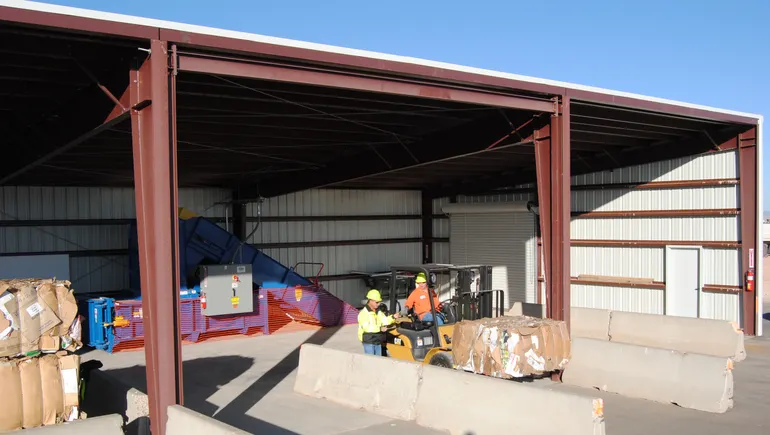
In Missouri, the Boonslick Regional Planning Commission received $1.04 million to serve four counties. The commission is using part of the funds to build a new warehouse, which will increase storage space at the East Central Missouri Recycling Center for collected cardboard, plastics, and paper by at least four times.
The extra space will allow the commission to store materials until they accumulate enough weight or volume to attract buyers. The space even allows the center to temporarily hold materials during market changes, waiting for better selling opportunities, enabling the commission to maximize sales revenue and reduce reliance on annual funds that Walch applies for each year.
"The only source of revenue for the recycling center is the return from selling products," said Chris Walch, the commission's recycling center manager. "Unless you charge for everything, you're just a drop-off center."
In western Alaska, Kawerak—the official SWIFR recipient serving 20 federally recognized tribes in the Bering Strait region—also plans to build large processing facilities. The organization currently has no facility to process recyclables, and environmental coordinator Vanessa Tahbone said sorting has been done outdoors for years. A $1.5 million grant will enable processing indoors in any weather and help purchase a baler for various materials.
Data-driven decisions
Data on the types and quantities of recycled materials helps strengthen SWIFR applications. Some places have this information due to tracking requirements.
For example, in Virginia, solid waste planning units submit recycling rate reports annually or every four years based on the population served. Kerns and her colleagues used annual reports that NSVRC submitted to the Virginia Department of Environmental Quality when revising their solid waste management plan in 2022.
NSVRC data showed that recycling rates had declined by up to 12% over the past five years, and the number of municipalities offering curbside recycling services dropped from nine to three. The commission hopes to improve these statistics, so it is using part of the grant funds to provide curbside recycling bins to towns and cover the costs of broader collection contracts spanning multiple communities. The intent is to bear the financial burden of establishing the service, which is ultimately paid for by each locality, Kerns said.
Elsewhere, however, obtaining reliable data is a challenge. The Nebraska Recycling Council wanted to apply for competitive grants, said Maddie Ferber, the nonprofit's former program director, but the state has limited data.
The council sends an annual survey to each municipality asking about recycling content or community issues, but responses are voluntary and few complete it. Last year, in thispredominantly ruralstate, only 50 of over 500 municipalities participated. Although Nebraska encourages local governments to collect the same information, it is not mandatory.
"If we can't accurately describe the situation, applying for grant programs like SWIFR becomes quite difficult," Ferber said.
Ferber knows one reason for low survey responses: rural county clerks have heavy workloads and high turnover, meaning current staff are often either catching up on long to-do lists, still learning their duties, or both.
Other smaller towns and governments may face similar issues. During the pandemic, local government employment generally declined. A report from the National League of Citiesreportfound that the sector saw a larger decline between 2020 and 2022 than any other industry.
Frequent staff turnover or vacancies in rural areas can also make keeping up with waste-related grant management a challenge.
At Kawerak, Tahbone provides technical assistance to member tribes, many of which receive grants from the EPA's Indian Environmental General Assistance Program. The grants require quarterly reports. Due to high turnover in tribal positions handling the paperwork, Tahbone often guides new employees through the process.
On the other hand, retaining dedicated staff is equally important to the success of recycling programs.
Kawerak's collection system began in 2010, when the organization's environmental program director, Anahma Shannon, used various grants for a hazardous waste return system. Nearby tribes are only accessible by boat or plane, so local airlines completed deliveries and returned to Nome with items like televisions.
Since then, Kawerak has expanded the approach to other recyclables. Shannon is a "go-getter," Tahbone said. "She has a broader vision and bigger plans."

Learning how to scale
In New Mexico, an ambitious individual's influence is also evident, showing how rural areas can expand their programs.
In 2010, the New Mexico Recycling Coalition began using $2.79 million from the American Recovery and Reinvestment Act tobuild a stronger rural recycling network. These funds were redistributed to six new municipal "hubs," two existing hubs, and more than 40 "spokes" serving as drop-off points. Not all of these locations are still operating today, but those that remain often have staff who have been there since the beginning. Retirement waves—especially during the pandemic—have made replacing long-term employees difficult, said Sarah Pierpont, NMRC's executive director.
Even if someone in a location fully supports recycling, New Mexico's initiative has other eligibility requirements for becoming a hub or spoke. Preferred candidates for recycling infrastructure are limited to a few places that NMRC has identified as optimal locations for collection points. A "waste shed" map shows how trash and recyclables flow through the area and reveals locations that could serve as convenient drop-off points for multiple people.
The map enables infrastructure to be logically laid out. In rural areas, Pierpont said, "every county and city has its own landfill and its own recycling center—that's a waste of resources because they don't need to be 20 miles apart." If processing and collection equipment are too close, programs start competing for recyclables, which need to be consolidated for any organization to sustain operations by selling processed materials.
SWIFR recipients have similar strategies to ensure their physical coverage is large enough to both encourage recycling and support profitable or at least break-even operations.
The Otoe-Missouria Environmental Department in Oklahoma has provided recycling services for #1 and #2 plastics, aluminum, paper, and cardboard to the Otoe-Missouria Tribe for years. The tribe is small and rural, with several other communities within a 30-minute drive. Its SWIFR grant application—which ultimately received $1.5 million—aimed to serve these other tribes.
"Given our geographic proximity and the ability to staff with community or nearby personnel, it is more feasible to establish one facility," wrote Angela Heim, environmental director of the Otoe-Missouria Tribe, in an email.

In Missouri, part of the space at the Boonslick Regional Planning Commission's new storage and processing center will be used to store materials collected by its own trailer, which parks once a month at 20 different communities as a drop-off point.
Some nearby recycling centers struggle to collect the quantities buyers need. Once there is space, Walch hopes to act as an intermediary to help consolidate material volumes.
"This will give them more funds than before to help sustain operations," Walch said.
Despite careful strategic planning and resource allocation, rural communities' plans to build recycling infrastructure can still be disrupted if buyer behavior changes dramatically. The reliability and stability of market demand are issues facing rural areas, which the EPA's National Recycling Strategy aims to address.
In Nebraska, Ferber has witnessed a collection program disappear because a cardboard and paper operator decided the proportion of residential materials no longer met its needs.
Rural SWIFR recipients are considering these market factors, but they say that even if markets change, they remain motivated to find ways to provide recycling services due to resident support.
"People understand that recycling is a quality-of-life issue, and they want to provide this service to residents," Pierpont said. "The question is just how to solve the logistics and funding."
This article first appeared in Waste Dive's Recycling newsletter.Sign up for the weekly email here.。