
California Treasurer Fiona Ma: From Combating Metal Theft to Promoting the Circular Economy, a 'Garbage Enthusiast'
California Treasurer Fiona Ma has been deeply involved in the waste and recycling industry since entering politics in 2002, from legislation against metal theft to financing the circular economy, with influence spanning policy, industry, and campaigns. This article reviews her career trajectory, industry relationships, and prospects for the 2026 lieutenant governor race.
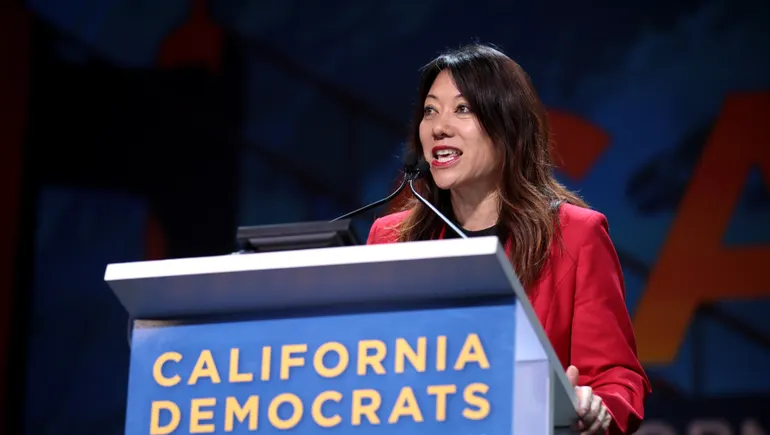
California Treasurer Fiona Ma's initial foray into the waste and recycling industry began with fighting crime. The certified public accountant entered politics in 2002 when she was elected to the San Francisco Board of Supervisors. After joining the California State Assembly in 2006, she introduced legislation targeting criminal gangs involved in metal scrap theft and the state's container redemption value (CRV) program.
"People were taking municipal bike racks to exchange for cash, which was crazy," she recalled. "They could get cash on the spot, with no way to track who brought them in." The bill passed in 2008, requiring a 24-hour waiting period for payments to identify offenders with prior records.
Ma became California Treasurer in 2018, and her focus on the waste and recycling industry goes far beyond that of a typical official, a focus that has spanned her career. Over the past two decades, she has remained involved in recycling policy and frequently posts photos on social media of her and her father dropping off materials at San Francisco recycling centers. Her interest extends far beyond the state's CRV program.
She has become a regular at waste and recycling industry events and has toured hundreds of waste facilities across California, other parts of the U.S., and Canada. Ma proudly calls herself the "Garbage Lady" and advocates for women's participation in the industry through the affinity group "Women in Solid Waste & Recycling." She is also a regular speaker at WasteExpo, the industry's largest trade show.
Ma has been outspoken on plastic pollution, urging the California Public Employees' Retirement System (CalPERS) to divest from oil and gas companies she believes are behaving improperly. CalPERS recently voted against the board of ExxonMobil after the company sued a group of activist investors. This friction is particularly important for the recycling industry because the California Attorney General is still investigating ExxonMobil's plastics business.
Now, Ma's goal is to run for California Lieutenant Governor—the state's second-highest executive office. She faces several potential candidates, but only one has officially announced so far.
Ma has faced some legal hurdles, including a sexual harassment and discrimination claim filed by a former employee. She denied the allegations. According to a Politico report from August 2024, the former employee agreed to drop the lawsuit and reached a separate $350,000 settlement with the state. Additionally, per KCRA's April 2024 report, the California Treasurer's Office received a document request from the FBI regarding an unspecified investigation, but Ma herself was not directly implicated.
Waste and recycling industry observers say that if Ma wins the lieutenant governor election in 2026, the industry could benefit from potential policy actions, more government funding, job growth, and industry expansion. She could also use her influence to hold waste haulers or other stakeholders accountable if they fail to advance sustainability efforts.
Help save resources, avoid landfills! ♻️ Join https://t.co/htNLuntG0p, experience San Francisco's innovative CRV program. BottleBank uses advanced technology to automatically count bags and credit CRV. Get your money back easily. "Recycling pays," I received $12... pic.twitter.com/GLh9vkxWgZ
— Fiona Ma, CPA (@fionama) February 17, 2024
An eager learner
One of Ma's earliest political battles occurred over a decade ago, centered on Waste Connections' Potrero Hills landfill in Solano County. At the time, environmental groups advocated for limiting the amount of waste processed from surrounding cities.
Ma said her goal was to ensure that "local governments cannot override our waste management system through individual ordinances," because the system is designed to operate at a regional rather than local level. She argued that otherwise it would constitute "garbage discrimination."

Rachel Oster—then serving as Director of External Affairs at Recology—met Ma around that time. Oster, also a co-founder of "Women in Solid Waste & Recycling," now runs a consulting firm. She, along with Erin Merrill, who also previously worked at Recology, and Ma's campaign manager Tanner Kelly, recently co-founded the "Recycle Right Coalition."
"Fiona is truly fascinated by waste and recycling because, to convey the importance of the issue to legislators, her staff had to deeply understand where and how waste was generated and disposed of in each legislator's district, and she realized it was a statewide issue," Oster said.
"That's when she started touring facilities and attending various meetings to educate herself... She's genuinely an eager learner."
Those early tours opened Ma's eyes. "Once you tour one, you think, 'Wow, I didn't know this was so complex,'" she said, citing the complexities of managing used batteries and textiles as examples.
Supportive, but not always in agreement
The waste and recycling industry has recognized her advocacy, contributing to Ma's various campaigns, including large haulers such as Athens Services, Recology, Republic Services, and Waste Connections, as well as the political action committee of the Resource Recovery Coalition of California. Over the years, industry-related groups and individuals have donated at least $200,000 to Ma.
Nevertheless, Ma's positions have not always aligned with industry groups. For example, she expressed support for a state bill introduced this year that would allow organizations to collect waste (organic or non-organic) in jurisdictions without a franchise permit, provided the franchisee does not collect those items. The bill failed to advance.
The Resource Recovery Coalition of California, Republic, Recology, WM, the California Compost Coalition, and other industry and labor groups, including the California Teamsters, opposed the bill. According to legislative analysis, they argued it would allow operators to enter the market without oversight and could endanger public health by allowing "inexperienced entities" to collect and process food waste.
Supporters of the bill included startups and groups focused on waste reduction, such as Ridwell and Divert. The "Recycle Right Coalition," composed of Ridwell and Divert members, sponsored the bill, saying it would clarify ambiguity for consumers about where and how to send materials for reuse or recycling.
Ma said she is encouraged by new market entrants addressing food insecurity and the climate impact of organic waste through edible food recovery and recycling. But she added that these companies must compete with those whose business models may place less value on such options. "So what I'm really focused on now is how and who can keep resources out of landfills," she said.
Waste Dive contacted two individuals at RRCC-affiliated haulers who are familiar with Ma. One declined the interview request, citing that their position does not allow commenting on elected officials; the other was unavailable due to paid leave.
Despite some tension around the evolution of collection franchises in the state, Ma still has a large number of allies. She delivered a keynote speech at the California Resource Recovery Association's annual summit last year. After the event, Heidi Sanborn, former director of the California Product Stewardship Council and current director of the National Stewardship Action Council, said of Ma's campaign: "We need people like her in higher positions. That way we get access and good policies."
Halo Glass Recycling has built a state-of-the-art glass processing facility in Modesto, California, converting glass from buyback centers and material recovery facilities into color-sorted, furnace-ready cullet for the glass container industry. The facility is located near Gallo Glass, the largest glass plant in the U.S... pic.twitter.com/ByKjfSM02N
— Fiona Ma, CPA (@fionama) February 23, 2024
Site visits and economic impact
When China began enforcing its "National Sword" policy, Ma (then serving on the California Board of Equalization) said recyclers complained to her about mountains of recyclables piling up, fearing they would have to landfill them. She turned to her friend Jay Hansen, who runs a nonprofit called the California Foundation for Environment and Economy (CFEE). CFEE works with legislators and regulators to advocate on issues like energy and transportation. CFEE began delving into recycling and circular economy work, including organizing trips to cities outside California to show legislators, waste associations, and other stakeholders how recycling innovations can be implemented.
It was on one of these trips that Doug Kobold, executive director of the California Product Stewardship Council, first met Ma. He said having her, along with local legislators and industry stakeholders, "on the ground on these tours" makes a real difference. "They can see firsthand and understand what actually works."
This is especially important for someone like Ma who can influence where funding goes, directing it toward new innovations or pilot projects with the most potential to address industry gaps and create jobs. "For every job lost at a landfill, the recycling industry gains four or five jobs," Kobold said, hoping Ma can become an advocate for developing the state's recycling infrastructure—especially if she becomes lieutenant governor.
Kobold acknowledged that building infrastructure in California faces steep regulatory hurdles due to the state's strict permitting and environmental review processes. But he believes Ma can help support more investment. "Where she can have the most influence is in providing financial support to get these facilities running as we push to process more materials in-state," he said. "It costs more to site and develop a facility in California than to go to Nevada, Arizona, or even Texas, and that keeps happening."
As Treasurer, Ma oversees a tax-exempt bond financing program through the California Pollution Control Financing Authority. She said many applicants often deploy technology to convert methane into energy, and she emphasizes accountability. "I visit after projects are approved to make sure they are actually doing what they described in their applications," she said.
"Treasurer Ma is the first constitutional officer in California to care so deeply about resource efficiency and use her office to finance businesses advancing a fair circular economy," Sanborn of NSAC said in a statement.
Oster also expects that whether or not Ma becomes lieutenant governor, she will continue to be influential in policy. "She believes the solid waste and recycling industry is key to achieving a circular economy," Oster said. "She is very supportive of progressive policies like producer responsibility and mandatory organic waste processing. I think she sees a real opportunity: as the industry transforms, it will bring potential investment, which means more jobs and in-state infrastructure."
Editor's note:This article has been updated to reflect the outcome of the sexual harassment allegations against Ma and to add context about the 2026 lieutenant governor race and KCRA's earlier reporting.
Correction:A previous version of this article incorrectly identified the county where the Potrero Hills landfill is located. The landfill is in Solano County.