
Clean-Seas pyrolysis plant secures key West Virginia construction permit
The West Virginia Department of Environmental Protection has approved a critical construction permit for Clean-Seas' pyrolysis plant in Belle, West Virginia. The 60,000-square-foot facility, designed to convert hard-to-recycle plastics into pyrolysis oil at 50 tons per day, has faced significant community pushback over cumulative pollution impacts and proximity to schools. The project has received state financial incentives, including a $1.75 million forgivable loan and a $15 million bridge loan, and is moving forward amid broader regulatory debates over chemical recycling.
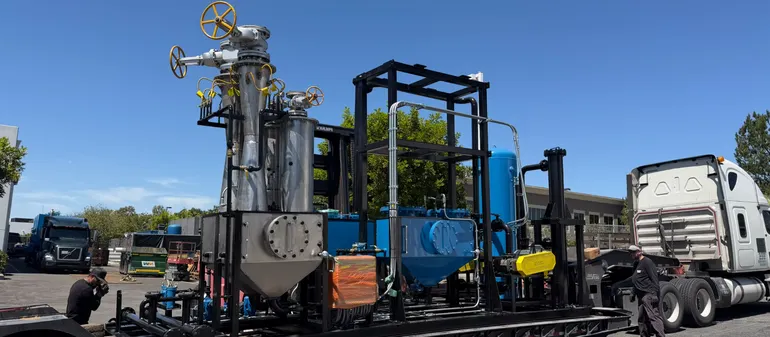
Key Developments
- The West Virginia Department of Environmental Protection has approved a key construction permit for Clean-Seas’ planned pyrolysis plant, a critical final step for operations in Belle, West Virginia.
- Clean-Seas, a subsidiary of California-based Clean Vision Corp., is building a 60,000-square-foot, 50 tons-per-day facility designed to convert “hard-to-recycle” plastics into pyrolysis oil.
- The project has faced major pushback from local residents concerned about cumulative air and water pollution impacts and proximity to area schools. The Ohio River Valley Institute criticized the permit decision as “rolling back critical pollution safeguards.”
Project Background and Incentives
The pyrolysis facility is advancing despite tensions between residents and state agencies. The state has offered Clean-Seas several financial incentives, including a “forgivable performance-based” state loan of $1.75 million in 2023 and a West Virginia Economic Development Authority bridge loan of $15 million in 2024.
When Clean-Seas first signed its memorandum of understanding with the state’s department of economic development in 2023, it envisioned processing 100 tons per day of plastic starting in 2024, eventually scaling to 500 tons per day. The company has since scaled back its estimated output and extended its timeline.
Construction began in early 2025. In August 2025, the company announced it had accepted its first delivery of plastic feedstock to prepare for a Q4 commissioning, but the new timeline remains unclear. Clean-Seas did not respond to a request for comment as of press time.
According to its website, the company plans to create 40 new technical and operational jobs in eastern Kanawha County, with more openings and expanded capacity “soon after commissioning.”
Company Track Record and Other Projects
This facility would be Clean-Seas’ first in the United States. The company acquired its first pyrolysis unit in November 2021 in India, which began operations in early May 2022, per its 2025 annual report. It also holds a majority stake in a 20 tons-per-day pyrolysis facility in Morocco, which began operations in April 2023. In 2022, the company announced a partnership with Arizona State University to launch a Phoenix facility converting plastic feedstock into “clean hydrogen,” but no updates have been announced since.
Community and Expert Concerns
In a July report, the Ohio River Valley Institute—a think tank opposing numerous chemical recycling projects—questioned Clean-Seas’ operations and outlook. Although a feedstock agreement has been announced, “no buyer for the product has been announced,” wrote Tom Torres, the institute’s chief of staff.
The institute also questioned revenue projections. Clean-Seas projected gross revenue of $6.2 million from the facility in 2026 and nearly $31 million the following year, according to a January 2026 letter to shareholders.
The institute criticized the state’s Division of Air Quality for approving the permit, saying it ignored legitimate environmental concerns. The division maintains the project meets all state standards.
In a July letter to the Division of Air Quality, Kanawha County commissioners echoed resident concerns about air and water quality impacts, as well as proximity to schools and neighborhoods. The facility entrance is less than 500 feet from an area high school and about 1,400 feet from public soccer fields, according to Department of Air Quality documents. The department said emissions would not surpass requirements and it will enforce minor source pollution requirements.
Residents also worried about cumulative emissions from existing industrial sites—such as Chemours, Optima Chemical, and Covestro—particularly because the facilities sit in a narrow river valley that can trap pollution during atmospheric temperature inversions.
“The Upper Kanawha Valley already contains numerous industrial operations and transportation corridors that affect local environmental conditions,” commissioners Ben Salango and Natalie Tennant wrote. “Residents have therefore questioned whether emissions from the proposed facility have been evaluated not only in isolation, but also in combination with emissions from existing industrial sources throughout the valley.”
In its written response, the department said air impacts would be “well within protective ambient standards, even during stagnant valley inversion events.”
During a public meeting on July 15, residents expressed distrust that the company would prioritize health and safety. One resident said, “Industry after industry have left West Virginia poisoned… and we’re tired of it,” as reported by the West Virginia Gazette Mail.
Regulatory Context and Industry Headwinds
Clean-Seas’ project moves forward amid proposed federal regulatory changes affecting chemical recycling. The U.S. EPA under the Trump administration has been outwardly supportive of chemical recycling as an economic booster. The EPA has proposed clarifying that certain pyrolysis technologies “are not forms of incineration” under the Clean Air Act. Administrator Lee Zeldin has advocated easing regulations for pyrolysis plants.
Plastics industry groups have long sought to classify chemical recycling as manufacturing rather than waste management, arguing this would create regulatory consistency. Environmental groups oppose reclassification, saying it would bypass stringent air regulations and that the industry’s benefits are exaggerated.
Several other chemical recycling projects have stalled recently. Braven Environmental announced in May it would no longer pursue a pyrolysis facility in Texarkana, Texas, despite state tax abatement assistance. Brightmark, another pyrolysis operator, announced in August it would pause its Indiana plastics-to-fuel operation for a “comprehensive evaluation” of technology. That company filed for Chapter 11 bankruptcy in March 2025.