
rStream's AI Recycling Technology: Post-Gillette Stadium Expansion Plans
After a successful deployment at Gillette Stadium, rStream plans to expand its AI-driven recycling sorting technology to airports and other venues, backed by a $1.25 million DOE grant and a fifth-generation system in development.
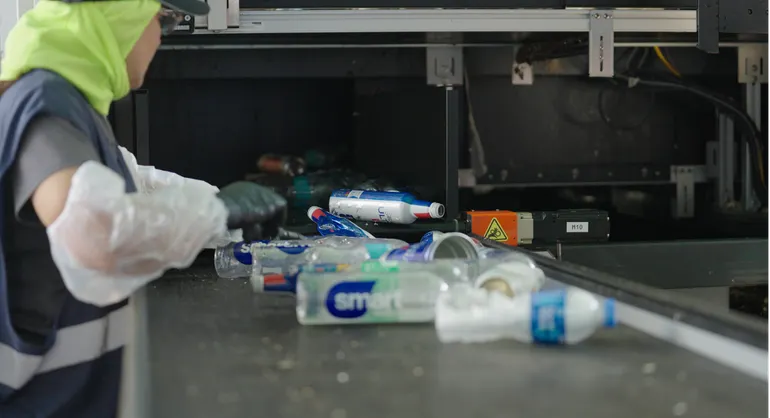
For visitors to Gillette Stadium in Foxborough, Massachusetts, it is a destination for Patriots games or recent World Cup matches. But for AI-powered robotics sorting company rStream, the venue serves as a testing ground to advance its evolving technology while supporting the stadium's waste diversion goals.
rStream's co-founders, Ethan Walko and Ian Goodine, view stadiums, airports, and universities as a unique niche for the company's sorting technology. Designed to fit in smaller spaces and target recyclables from lower-throughput areas, rStream's system is positioned as an alternative to larger-scale sorting technologies that the company argues are not feasible for these logistically challenging locations.
The company also plans to market the technology in "lower resource areas where you can't justify the investment in a 40-ton-per-hour MRF just because you don't have the materials in that region," Walko said in an interview with Waste Dive.
Insights from the Gillette Stadium partnership will help refine rStream's offerings as it prepares to launch the fifth iteration of its sorting technology and expand to new locations in the coming months. The effort is also supported by a new $1.25 million grant from the U.S. Department of Energy's Remade Institute, announced earlier this month.
Tailoring the technology for Gillette Stadium
For the Gillette Stadium partnership, rStream began working with the operations team in 2024 to design a recycling and waste diversion solution. The team had completed a full stadium audit the previous year and sought to increase the on-site waste diversion rate, according to Walko.
rStream automated the waste sorting process using a trailer-based system parked at the loading dock, where the operations team already stored waste and recycling near the stadium's compactors. The computer vision technology identifies and sorts the stadium's full waste stream on-site, separating recyclables, compostable materials, and trash. Win Waste is the contracted hauler responsible for handling Gillette Stadium's materials from that point.
rStream's sorting process achieves approximately 99% accuracy and eliminates the need for manual sorting, Walko said. Across seven recent stadium events, rStream sorted out 479,000 individual recyclable objects.
"This partnership with rStream helps us manage waste more responsibly and efficiently while creating a better working environment for our staff and providing data that helps us continuously improve our operations," said John Flaherty, senior vice president of operations at stadium owner Kraft Sports + Entertainment, in a statement.
rStream's data collection efforts log specific information about materials in the stream, creating a "digital record" of each event, the company said in a news release about the partnership.
This service is valuable for stadiums and other event centers that need data to meet reporting requirements, including certain MassDEP waste diversion regulations and building-specific LEED certification through the U.S. Green Building Council, Walko noted.
For the recent World Cup soccer games held this summer, FIFA encouraged every stadium, including Gillette, to "set ambitious goals for reducing the amount of waste they create."
"Big public venues like a stadium might have revenue opportunities tied to those [sustainability] requirements," Walko said, citing musical artists like Coldplay and Billie Eilish that have made sustainable stadium practices central to their tours. "So now you're starting to evaluate this on a whole new axis of, 'Oh, okay, our sorting program is actually unlocking all these huge opportunities, and if we're not doing it, but every other stadium is, then we're kind of falling behind.' So it's almost table stakes now at this point," he said.
rStream also customizes its technology for each venue, an offering Walko said is necessary to more accurately capture the needs and challenges of dynamic spaces like concert venues or airports.
"Our vision models are specific to sites because although you have the same general categories of waste, you'll always have differences in terms of the exact materials. If you want to get really high accuracy, it's good to make unique models that can run at each site," he said.
The Gillette Stadium model has been a valuable proving ground for the technology, said Ian Goodine, co-founder and CEO of rStream, in a statement. "We are not just dropping a robot on the loading dock. We are giving the building a smarter way to run one of its toughest operations."
What's next
rStream will next turn its focus to other venues and short-term projects in the coming months. Walko and Goodine hope to broaden its services at airports.
"Millions of people are traveling through the large ones every single year. There's dining areas, there's single-use materials and a variety of people coming from different backgrounds," Walko said. "When you get that transient population of folks, it's really difficult to communicate recycling rules effectively, and I think that's where we want to be able to bring automation to address that confusion and help to make sure materials are being handled accurately."
Later in 2027, rStream also anticipates releasing the fifth version of its system, which Walko said is meant to be a smaller and more compact model that is no longer on a trailer.
"That'll help it be scalable across more markets, whereas the current one is really tailored towards the stadiums," he said.