
New Trends in Door-to-Door Recycling: Curb-Side Recycling Services Break Traditional Category Boundaries
In response to the limited categories covered by curbside recycling programs, various paid door-to-door recycling services have emerged in the United States, provided by startups and large transportation companies, collecting items such as plastic film, foam plastics, batteries, light bulbs, and textiles, and handing them over to partners for reuse or recycling. These services prioritize convenience, adopting a subscription model with one to two pickups per month. The competitive landscape of the industry is evolving, with companies like TerraCycle, Ridwell, and Rabbit Recycling expanding their presence, while giants such as WM and Waste Connections are also participating in pilot projects.
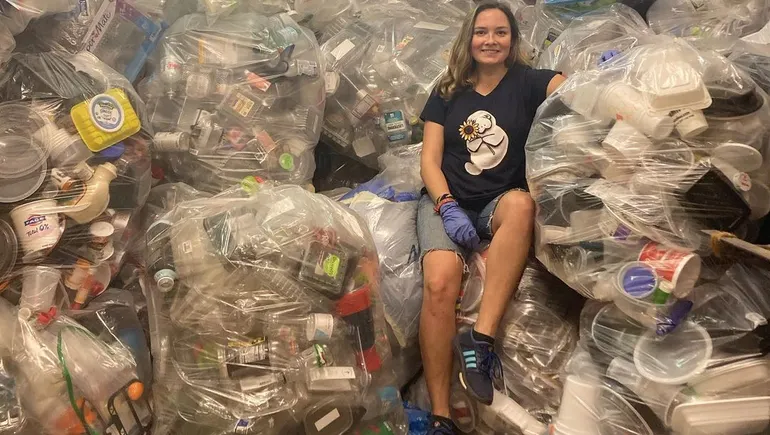
Curbside recycling programs typically accept core materials, but the range of approved items is limited, and consumers increasingly seek more ways to divert waste. Professional doorstep collection services are disrupting the traditional curbside model to meet this demand.
From startups to industry-leading haulers, these programs are emerging in multiple regions across the country. These new services collect items such as plastic film, clamshell containers, polystyrene foam, batteries, bulbs, and textiles from subscribers' homes and transport them to partners for reuse or recycling. Subscribers pay a fee for the collection service, which typically occurs once or twice a month.
Although many of these items already have drop-off or mail-in recycling programs, the concept of doorstep collection centers on consumer convenience. After all,convenience is often seen as a way to increase recycling rates。
"Our idea was that if we could find reuse and recycling opportunities for people and make it easy for them to get items to relevant organizations, maybe more people would participate," said Caleb Weaver, vice president of public affairs at Ridwell, a specialized recycling service in Seattle. "Sure enough, the idea has now grown."
Evolving competitive landscape
Four years ago, CEO Ryan Metzger founded Ridwell based on a project of collecting and transporting his own and neighbors' end-of-life but still valuable items to recyclers with his young son. Today, Ridwell serves six metropolitan areas, and the items accepted vary slightly depending on regional recycling partners. Typically, accepted items fall into four core categories: plastic film, textiles, batteries, and bulbs.
Similar businesses are emerging on the East Coast, with Rabbit Recycling founded in Philadelphia about two years ago. Co-founder Bryan Siegfried wanted to provide the community with convenient solutions to recycle items that are typically not handled and to rethink the traditional recycling system. Rabbit accepts a variety of items, including snack wrappers, foam, and rubber bands.
"Our entire business model is based on convenience, transparency, and making it easy for users to move toward zero waste," said Zoe Fuhrman, project manager at Rabbit Recycling. Finding recycling channels for items not typically accepted curbside "is too time-consuming for individuals unless they have a lot of free time, and most people don't."
This doorstep collection concept is not exclusive to startups. For over 15 years, TerraCycle has organized collection programs for hard-to-recycle items such as coffee capsules, cosmetic containers, and cigarette butts, mostly through drop-off or mail-in systems. In September, the company launched its first doorstep collection service, TerraCycle Home, in parts of New Jersey and Pennsylvania.

Subscribers choose the collection frequency and the number of bags they receive, which are used to deposit dozens of materials, including corks, glasses, and personal protective equipment. Third-party haulers contracted by TerraCycle are responsible for picking up the bags.
"We've always dreamed of bringing it to the curb in some way," said Tom Szaky, founder and CEO of TerraCycle.
TerraCycle recently also partnered with Casella Waste Systems to launch another doorstep collection service, TerraCycle Pouch, in Burlington, Vermont. The pilot combines Casella's transportation infrastructure and customer base with TerraCycle's end-market expertise in hard-to-recycle items. Customers subscribe to a certain number of on-demand collections per cycle and schedule times through an app.
The service launched in October. It is currently experiencing "strong interest" while working to expand to more people in the region, said Jeff Weld, director of community engagement at Casella.
"We recognize that some materials produced today are technically recyclable but cannot be scaled immediately," he said. "We are always looking for new ways to recycle more content, take items out of the waste stream, and put them to higher and better uses."
Transportation giants such as WM and Waste Connections—the first and third largest haulers in the country—have also joined. They are involved in a newRecycle+ program, which collects purple curbside bins filled by subscribers with over a dozen special items, including sheets and plastic produce bags. WM said it is not yet ready to discuss the program because it launched in July.
Modern business models
Industry professionals say specialized curbside recycling service providers adopt a different business model than traditional services. Typically, they aim to promote reuse and recycling for societal benefit rather than economic gain, with customer subscription fees covering recycling and transportation costs.
"We have always focused on providing recycling solutions for items that are currently not handled through municipal or curbside recycling, which are often profitable for local recyclers," Szaky said. "It all started with us seeking funding because the big problem with recycling cigarette butts or coffee capsules is that the cost is much higher than their value."
Rabbit Recycling even accepts items customers wish to donate and sends them to thrift stores, shelters, mutual aid organizations, and other small nonprofits.
"In our model, we always prioritize reuse," Fuhrman said. "People use our service because they care."
Ensuring local communities remain central and benefit is another priority for many specialized recycling startups. Keeping materials local after collection helps achieve this goal while reducing costs and pollution associated with long-distance transportation.
"We try to stay local because we are a public benefit corporation... We don't want to ship items farther than necessary," Weaver said. "Many creative reuse activities are done by local nonprofits."
While some partners are small local nonprofits, others are established national companies. For example, Trex partners with Ridwell to convert collected plastic film into composite decking boards.
Some of the glass collected by Rabbit Recycling in the Philadelphia area is crushed and used to reline local riverbanks. Regardless of the final use, Fuhrman says transparency about where materials go and how they are used is crucial.
"We carefully vet our recycling partners and know exactly how materials are handled because we are committed to transparency with our customers," Fuhrman said. "We want to ensure we can fulfill that commitment by working with partners who also handle materials transparently."
TerraCycle works with Bureau Veritas to audit its recycling. This year, the agency conducted an audit and certified TerraCycle'stwo material streams: mixed flexible packaging and mixed rigid packaging. TerraCycle says these two streams have the highest volume across all its business lines, including over 98% of materials collected through TerraCycle Home and TerraCycle Pouch.
TerraCycle's audit practices and certification were crucial for Casella in considering the new pilot partnership, Weld said. Casella aims to ensure "that any partner we work with has that, because we know the commitment we make to our customers: if we say we will recycle, we will recycle," he said.
Growing pains
Specialized recycling collection involves considerations similar to traditional recycling, as well as unique challenges.
Transportation costs are a common concern for haulers of all types of materials. Casella, Rabbit Recycling, and Ridwell own and operate their own vehicles. TerraCycle does not, and does not intend to, Szaky said. It relies on third-party logistics providers for its own services and on Casella in joint projects. Szaky foresees adding more transportation partners in the future.
Scaling fleets appropriately is demanding, especially for emerging, unproven markets or services.
"Every time you put a truck on the road or have a driver seated, you must ensure enough density to be efficient," Weld said.
Overall program costs are a major challenge. Currently, specialized curbside recycling services rely on customer fees to fund operations. But balancing costs with added value requires effort, as does retaining customers during difficult times or when the novelty of new programs fades.
"Whenever you ask customers to pay for a service, the service must have clear value," Weld said.
As with traditional recycling, especially mixed recycling, contamination is a concern for some specialized businesses. Rabbit Recycling transports materials but does not wash them, so it requires materials to be clean and dry at collection. They send photos of unacceptable items to customers and discard them, which has proven to motivate behavioral change, Fuhrman said. Ongoing education is a significant part of the business.
"You don't learn how to handle recycling in school," she said. "It's not the easiest thing in the world, and we recognize that and appreciate the effort our customers put in."
Another looming consideration is what happens if more haulers that dominate the traditional recycling industry enter the specialized space, such as WM and Waste Connections' involvement in Recycle+.

This situation has put Ridwell in litigation. In one case, Ridwell sued to terminate a program in Washington County, Oregon, highly similar to its own model. The judgedismissed the lawsuitin August, and Ridwell has appealed. The startup also filed another lawsuit, still ongoing, stemming from a Portland-area hauler claiming Ridwell infringed on its exclusive franchise, and Washington County issued a cease-and-desist order to Ridwell.
Ridwell argues that because of different operations and equipment, it does not directly compete with franchise haulers. In fact, using ordinary compaction trucks to transport hard-to-recycle materials is not feasible due to risks of clogging, tangling, or cross-contamination, Weaver said. Instead, he believes the differences open doors for cooperation rather than competition, and complementary services can achieve the overall goal of increasing waste diversion.
"The services we provide help address some of the challenges haulers face in increasing the amount of divertible materials," he said. "We hope these opportunities will continue to grow as people learn about us and how we can be a beneficial complement to existing diversion efforts."
The long-term viability of specialized recycling programs has not yet been proven. In this regard, a recentBloomberg articlequestioned the viability of certain end markets and processes at TerraCycle. For example, the article stated that about 20% of materials collected by TerraCycle may be stored for long periods.
Szaky told Waste Dive that 95% of materials collected through the Casella partnership are processed quickly, and 5% may be stored to accumulate enough volume for processing. He also noted that TerraCycle only collects materials that local recyclers do not handle due to lack of profitability, so TerraCycle relies on stakeholder funding, such as household service subscription fees.
"Therefore, our model is sustainable and profitable, which is why we have achieved 19 years of direct revenue growth, including 2022, and we do not expect that to change in the future," Szaky said.
The way forward
Specialized curbside recycling service providers generally expect business expansion in 2023 and beyond. This may occur through adding new markets, new materials, or both.
"We hope to enter more markets next year," said Ridwell's Weaver. "In the long term, we expect the service to continue to develop and grow—items like multi-layer plastic packaging will allow us to offer members large-scale recycling opportunities."

Rabbit Recycling is not yet ready to expand to new geographic markets and currently accepts almost any material it can handle, Fuhrman said. But it is focusing on expanding commercial sector services to "help businesses divert recycling in a trustworthy way," she said.
Szaky plans to expand the TerraCycle Home program in New Jersey next year, primarily geographically, but possibly also by adding material types. He said the program "is working to achieve the necessary key performance indicators so we can decide to expand," and "so far, we have seen very good results."
Casella plans to run the pilot with TerraCycle for a period and use the collected data to decide whether and how to expand such services.
"If this develops into a way to partner with brands to get more recycled content, that would also be great," Weld said. "We want to recycle more, recycle better, and deliver to customers."