
California's Organic Waste Recycling Law May Reshape the Future of Landfills
California's SB 1383, as the most comprehensive organic waste reduction policy in the nation, is forcing landfill operators to rethink their business models. This article explores the law's potential impacts on landfill capacity, private company strategies, and the national waste market.
Editor's note: This article is the sixth in a series exploring the market effects of California's comprehensive organic waste reduction law, SB 1383. The series consists of multiple parts.
If landfills are no longer the dominant materials management infrastructure, what will the waste industry's business model look like? California's new organics recycling law may offer an early indication.
Although California does not face an imminent disposal capacity crisis like some other states, growing public awareness that landfills exacerbate climate change has added urgency to the implementation of SB 1383. The California Environmental Protection Agency (CalEPA) lists landfills as the state's second-largest source of methane emissions and the largest single-point source statewide, at a time when methane's greenhouse effect is receiving increased international attention.
Waste management professionals in both the public and private sectors often say that for many types of materials, landfills are not their preferred disposal method. Meanwhile, relatively low tipping fees in various parts of the United States are often used as a benchmark for assessing whether offering organics recycling services is economically viable.
Policy requirements, such as California's mandatory goal of reducing organic waste disposal by 75% by 2025, are seen as a way to change this cost equation. Today, the state's landfill owners are working to adjust their operating models, and the collection methods of private operators are evolving accordingly.
Impact on landfills
CalRecycle says the goal of SB 1383 is to reduce the amount of organic waste entering landfills, but whether the law will reduce the need for future landfill expansion approvals, and how quickly it can change landfill intake volumes, is still too early to tell.
Earlier this year, CalRecycle Director Rachel Machi Wagoner said that given the law and other curbside recycling efforts, she expects the state will not need to approve any new landfills. Ideally, she believes the state should not approve any expansion projects either.
"The direction should be the opposite," Wagoner said. "I think, going forward, that would not be a good business model."
As the most populous state in the nation, California has long grappled with the role of landfills, including studies in the 1990s aimed at confirming the remaining capacity of each county. Based on 1993 statistics, state consultants estimated that California may have had about 28 years of landfill capacity at that time. Since then, both per-capita waste generation and total disposal have increased, although recycling volumes have also grown significantly.
While CalRecycle has not released updated projections on landfill space, data collected by Waste Business Journal estimates that California's landfills have an average remaining permitted capacity of at least 26 years. The data also shows that public entities are the primary owners of the state's landfills, holding about 55% of the capacity.
It is widely acknowledged that even if SB 1383 is fully successful, disposal facilities will still be needed to handle other materials. Nevertheless, minimizing and diverting organic waste will go a long way toward extending the lifespan of these landfills. This expectation has prompted several jurisdictions to adjust their priorities.

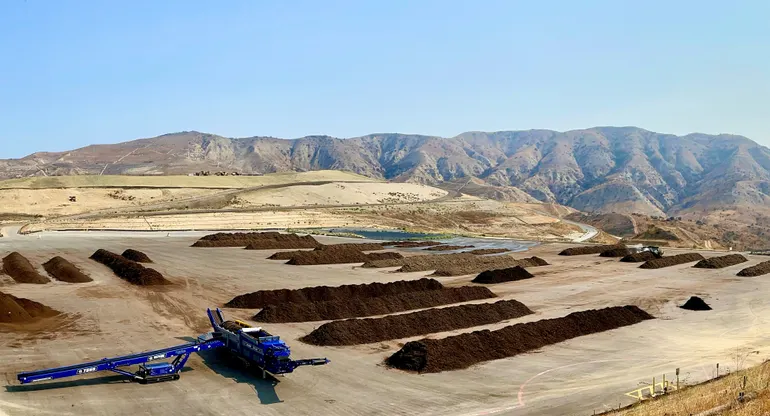
Orange County, which claims to have one of the largest landfills in California, is a prime example. OC Waste & Recycling (OCWR), a public agency that operates three landfills but does not handle collection, expanded its operations to include three composting sites starting around 2017. SB 1383 was one driving factor, as was another law (AB 1594) that prohibits the use of green waste as alternative daily cover.
"As an agency, our job has shifted, and so has our mindset. It used to be all about pushing dirt, spreading it, covering it, protecting public health and the environment," said OCWR Director Tom Koutroulis. "Landfills are a finite resource. Our business model was to fill up and close. We go from an asset to a liability."
Following recent permit renewals, OCWR's three landfills are authorized to operate until 2036, 2053, and 2102, respectively. But the agency expects that with the implementation of SB 1383, intake volumes will significantly decrease and its revenue structure will change.
David Tieu, deputy director of landfill operations for the agency's central region, said the three green waste composting sites will ultimately have a daily processing capacity of 735 tons, using open windrow composting, and that the agency is becoming increasingly efficient in permitting and construction.
OCWR's third composting site is scheduled to come online in the coming months, initially using a windrow system but eventually equipped with more advanced covered aerated static pile composting technology for food waste composting. The agency plans to replicate similar systems at its other two sites to scale up food waste composting, as the region lacks sufficient processing infrastructure, and Koutroulis said "Southern California will need significant investment."
OCWR said in 2021 that it was preparing as quickly as possible, which Koutroulis described as "a sprint, not a marathon," but like many other agencies in the state, the task of complying with SB 1383 is daunting. OCWR received a $3 million grant from CalRecycle earlier this year to accelerate the expansion of some of its composting operations. OCWR expects its third composting site to come online in early 2023.
Although OCWR's transformation is seen as one of the most notable cases, because relatively low tipping fees in Southern California had previously limited investment in organic infrastructure, several other local jurisdictions are equally motivated to extend the lifespan of their disposal sites or adjust their priorities.
San Diego's Miramar Landfill will host a composting facility to process materials generated by the city, while hoping to extend its lifespan to 2030 or beyond.
Placer County's Western Regional Sanitary Landfill is permitted to accept waste until 2058, but is expected to reach capacity earlier without expansion. The Western Placer Waste Management Authority (WPWMA) previously stated that no final decision has been made and hopes expansion is a last resort.
"If we can keep materials out of the landfill, we can extend the life of this asset and reduce spending on landfill development," said Eric Oddo, project manager at WPWMA. "I would love not to have to develop that land as a landfill."
As with any regulation, observers also note that much depends on how the law is enforced and how market factors recognize the value of such changes.
"It can be said that if you separate organics from landfills, you can indeed significantly reduce methane emissions," said Nora Goldstein, editor and publisher of BioCycle magazine, adding that this could theoretically have quantifiable value. "The recovered organics must have equally strong dollar value and be used in agricultural production, for example, thereby reducing the use of chemical fertilizers, which are fossil fuel products."
From a national perspective, this transition could have financial implications for large companies operating in the California market—including the three giants of the U.S. industry. According to Waste Business Journal data, Republic Services, WM, and Waste Connections are the largest owners of private landfill capacity in the state.
The latest annual filings from Republic, WM, and Waste Connections all note in various forms that while diversion activities are environmentally beneficial and create new business opportunities, they may also affect the operations and profitability of their landfills—for WM, landfills "currently provide our highest operating margins."
"Diversion targets mean a significant reduction in landfill volumes, so there are clearly trade-offs," said Noah Kaye, senior research analyst at Oppenheimer & Co., while "this should be reflected in higher collection prices and higher tipping fees."
While this may provide financial compensation for lost disposal revenue, Kaye (and agencies like CalRecycle) also predict further ripple effects.
"More bins create more revenue opportunities on the collection side, and may actually lower processing costs because there is no longer a mixed waste stream, which reduces contamination rates," he said.
Collection business models
Collection has traditionally been the most profitable business line for private haulers, but in the context of SB 1383, companies' strategies may vary depending on the types of assets they own.
Some observers believe that large haulers' preference for three-bin source separation schemes is driven by profit motives. In the final weeks of legislative negotiations in August 2016, some of the state's largest haulers appeared on the list supporting SB 1383. However, those involved in the process consider this profit framework unfair.
"I think they recognized that this was the direction the state wanted to go for climate reasons, so they sat down at the negotiating table and said, 'Okay, how do we make this work?'" said Nick Lapis, advocacy director at Californians Against Waste, a bill supporter. "They certainly weren't the drivers; many negotiations were conducted with them."
According to legislative reports from the final weeks of that session, Republic Services, Recology, and CR&R were among the few haulers that publicly supported the bill.
Labor organization representatives—another key stakeholder in this system—said source separation would certainly create more jobs because additional routes would be needed, but they disagree that profit motive was the primary factor.
"For the elected officials who adopted these policies, I think the primary driver was environmental goals. It happens to be a win-win for labor too, and there's nothing wrong with that," said Jim Smith, political coordinator at Teamsters Local 396, adding that this approach also yields higher-quality materials.
Athens Services, a company that does not specifically focus on three-bin collection, says its own model's key considerations are driven by infrastructure.
"We're not a company that owns landfills; we focus on developing technologies that divert materials from landfills," said Executive Vice President Gary Clifford.
Athens serves Los Angeles and other parts of Southern California and operates multiple facilities that can process various types of organic materials, including its American Organics composting site, which has a permitted annual processing capacity of up to 320,000 tons. In some cases, Athens also pre-processes materials before sending them to third-party anaerobic digestion facilities.
Although the company has seen several municipal customers recently shift to three-bin systems (which it believes is because it is perceived as an easier way to comply with SB 1383 regulations), it still offers multiple options.
Clifford said that in his view, it is best to first process containers that would otherwise be landfilled to capture as many recyclables as possible, even if it may be more costly, which is considered a departure from the approach of some larger competitors.
"We have to find ways to avoid the landfill, and that's why we built these different systems," Clifford said. "I think they like the three-bin system because they can send the black bin directly to their landfills, as it fits their landfill disposal business model. Our model is to process as much as possible first, which requires more resources."
Others also see SB 1383 as a potential turning point for haulers. While much attention has focused on the rollout of residential programs, commercial customers are another area that could change how the waste industry operates.
J. Michael Huls, a part-time professor at Santa Monica College and longtime industry consultant, said it is important to focus on large generators that may account for only a small percentage of accounts but produce the majority of waste. Finding creative ways to handle these waste streams, regardless of collection frequency or other traditional considerations, can help haulers sustain their business.
"I think part of the problem for some waste haulers is that they haven't moved beyond the 'garbage company' mindset. They need to become resource companies," Huls said.
"For collectors, not collecting something is not good business. But if they can make money by not collecting—for example, by renting out a small composting unit or micro-composting system and charging for it—they become more like a service company."

Looking ahead
The complex rollout of California's organic waste policy means it may take years to see significant reductions in landfill intake—but the success of the program depends precisely on that.
The state estimates that achieving these goals requires diverting about 20 million tons of organic materials from landfills annually, which is more than double the amount classified as composted or anaerobically digested in the state's most recent 2020 data. Given the numerous logistical and infrastructure factors involved, this may seem daunting, but professionals say progress should emerge gradually.
"Even in the first year, there should be fewer tons going to landfills and more tons going to organic facilities," Clifford said.
As for whether the widespread rollout of organics collection by the industry's largest haulers will have ripple effects in other states without their own policy drivers, Oppenheimer's Kaye said these changes in California are crucial for any business, and the potential to expand investment into new technologies—while potentially lowering costs over time—could extend beyond California.
"As this happens, the economics become more attractive, and there's an opportunity to bring these technologies to new state markets and even global markets," he said, noting that the key is the tipping point at which the concept is considered economically viable in a particular region.
Washington state this year became the latest to pass an organics recycling law, with its policy partly modeled on SB 1383, requiring 75% diversion by 2030. Several other states have less stringent policies, as well as local or county-level policies affecting regional markets. Additionally, broader interest in reducing disposal costs and associated greenhouse gas emissions has driven significant investment into organics recycling, regardless of policy drivers.
At this year's WasteExpo, Republic CEO Jon Vander Ark said customers are increasingly willing to pay more for curbside recycling services than for trash collection. He described organics recycling as "the next opportunity," although it will progress state by state.
"Twenty percent of the material in our landfills is organics, and I think there are many different innovations in post-collection processing. No one has really found a consistently viable solution from an economic or performance standpoint, but I think it's just a matter of time," he said. "Ten years from now, or even five, we'll be having a very different conversation."
Stay tuned for Part Seven, which will explore recent questions about whether the state can meet its goals and the implementation challenges facing industry participants.