
San Francisco Recology Bribery Case Follow-up: $36 Million Fine and Legal Risks Coexist
Recology was fined $36 million for bribing San Francisco officials. Although a deferred prosecution agreement was reached, lawsuits from former employees, municipal reforms, and potential charges remain unresolved.
Recology's public corruption scandal in San Francisco continues to unfold, having already cost the company millions of dollars in fines and rate refunds. After reaching a deferred prosecution agreement with the U.S. Department of Justice (including a $36 million fine), the company hopes to turn the page, but multiple signs indicate it may face more turbulence.
Although the broader investigation into the city's former Director of Public Works, Mohammed Nuru, continues, and court proceedings involving two former Recology employees are ongoing, the 100% employee-owned company is assuring stakeholders there is no cause for concern.
"This has been a challenging year and a half for our company, but I have important news to share with you—I believe this will help Recology get back on track," CEO Sal Coniglio told employees in a recent video. "This agreement allows us to acknowledge past mistakes while continuing to serve you for the long term. First, let me be clear: these errors and behaviors were wrong and unacceptable. We must ensure such incidents do not happen again."
According to the statement of facts Recology reached with the DOJ, former employees of its San Francisco group (Recology San Francisco, Sunset Scavenger Co., and Golden Gate Disposal & Recycling Co.) spent over $900,000 between 2014 and January 2020 to bribe Nuru in exchange for favorable treatment in municipal business. For example, they pushed the city to pay higher tipping fees at its Sustainable Crushing facility.
The filings show payments and benefits to Nuru included: approximately $150,000 per year from 2014 to 2019 paid to an unnamed nonprofit he controlled funds for; a total of $60,000 between 2016 and 2019 paid to another nonprofit for Public Works holiday parties; providing a job at Recology for Nuru's son; providing an internship for Nuru's son at another nonprofit (funded by Recology); paying $3,500 in funeral expenses for a Public Works employee; and two nights at an expensive New York City hotel for both men during a trip to inspect pneumatic trash collection systems.
"Now, under the agreement with prosecutors, Recology's San Francisco companies will pay fines and accept a charge of conspiracy to commit honest services fraud. Once Recology complies with all terms of the agreement, the charges will be dismissed," Coniglio said in the video, adding that the company will not pass the fines on to customers.
In admitting these actions, Recology will pay $29 million to the U.S. Treasury and receive credit for the $7 million related rate refund settlement it already agreed to pay the City and County of San Francisco in March. If the company complies with all terms, the charges will be dismissed three years after the court approves the final agreement. Recology noted that before receiving subpoenas or learning of the investigation, it had already strengthened compliance, held people accountable, brought in new leadership, and cooperated with the government—points the DOJ also mentioned.
"San Francisco residents were victimized for years by a bribery scheme involving a public contractor and a powerful, corrupt San Francisco official," Acting U.S. Attorney Stephanie Hinds said in a statement. "The SF Recology group and its parent company, Recology, Inc., are taking proactive steps to correct this blatant wrongdoing and have committed to full cooperation in the ongoing San Francisco City Hall corruption investigation."
Since the company reached a $100 million rate refund agreement in March (which led to a 6.796% rate decrease for San Francisco customers on April 1), the initial local anger has subsided somewhat. That agreement was based on overcharges discovered during Nuru's tenure. Meanwhile, a local working group is studying possible changes to the city's garbage collection system; a former employee is now cooperating with prosecutors; another former employee was indicted in mid-April, with next steps pending.
"Recology has clearly taken sufficient remedial measures to convince the DOJ that the likelihood of future similar misconduct is low," said Eric Beste, a white-collar crime partner at Barnes & Thornburg's San Diego office, who spent over two decades at the DOJ focusing on related issues. "Although the deferred prosecution agreement resolves the government's criminal investigation into Recology entities, there is good reason to believe former Recology employees will soon be indicted."
 Recology CEO Sal Coniglio speaks to employee shareholders in a September video
Image source:YouTube, filmed on September 29, 2021
Legal issues
The DOJ's latest agreement with Recology marks a turning point where the company acknowledges certain facts and takes responsibility through its local subsidiaries, but unresolved issues remain.
When charges against Paul Giusti, government and community relations manager for the SF Recology group (serving from 2012 to June 2020), first surfaced in November 2020, Recology denied broader involvement. "We must be clear: Recology did not provide $1 million in benefits to the former San Francisco Public Works director. That is not who we are," a company spokesperson said at the time. Recology declined to answer whether it still stands by that statement.
According to the agreed facts, the scheme primarily involved three former employees' interactions with Nuru. Giusti was usually the main contact. From January 2018 until his termination in June 2020, Giusti reported to John Porter, vice president and manager of the local group. Porter left the company in January and faced his own charges in April.
Previously, from 2014 to December 2017, Giusti reported to Porter's predecessor—referred to in the filings as "SF Recology Group Executive 2"—who was subsequently promoted to Recology's Chief Operating Officer, serving until July 2020. Mark Arsenault held those positions during the specified period and also served on the company's board, but could not be reached for comment.
External experts believe that, based on the facts provided so far, the extent to which others in the company were involved or aware remains an open question. Deferred prosecution agreements are sometimes tools for companies or their subsidiaries to take responsibility rather than individuals, and retirement may also affect prosecutors' assessment of ongoing criminal risk, but more charges are considered likely.
"We're not just talking about huge bribes, but ones that lasted over five years," said Craig Holman, a government affairs lobbyist at the nonprofit Public Citizen, who has tracked numerous such cases and called this one of the largest he has encountered. "It's hard to imagine a bribery scheme of this magnitude where all the senior officials responsible for such expenditures didn't know what was happening."
According to DOJ documents, Recology has been cooperating closely with federal investigators, noting that the company is undertaking a thorough overhaul of the internal processes and policies that allowed these issues to occur. The company has created new positions for an internal audit director and compliance officer, and frequently cites new leadership at the executive and board levels.
Coniglio was promoted from regional manager to Chief Operating Officer in July 2020, then became CEO in January following the retirement of longtime leader Michael Sangiacomo. Recology previously said the move was unrelated to the investigation. The DOJ only mentioned the company's former CEO, noting he demanded Nuru's son be fired after learning of his employment in 2017. Over the past year, several senior Recology employees have also departed.
The company's board has also undergone changes, including the exit of its longtime chairman and several members. Recology appointed new chair Christa Steele in January alongside Coniglio, and announced two new board members, Kim Box and Jeff Stiefler, on March 23—but all three no longer appear in any company materials. Steele's LinkedIn profile shows her board tenure began in 2017 and ended in April of this year, with a statement noting she "joined the board shortly before the company became a federal investigation target, and the investigation involves periods before I became a director."
Around March, Recology settled with San Francisco over inflated rate increases, which some viewed as a potential turning point, but the April charges against Porter brought new issues. Steele, Box, and Stiefler did not respond to multiple requests for comment, and Recology declined to answer questions about their tenures.
The company announced two new directors on April 23, including James Lam, whose election as chairman was also highlighted at that time. The company then announced three directors in June, calling it the formation of a "complete board."
Since spring, the case has been relatively quiet, but legal proceedings continue. In August, Giusti pleaded guilty to one count of conspiracy to bribe a local official and commit honest services fraud, and agreed to cooperate. He remains out on bail, with a status conference scheduled for February.
DOJ information repeatedly states that Giusti acted with the "knowledge and approval" of his former manager, and as the case continues, attention again turns to others. Porter has not appeared in court since his initial appearance in April. He remains out on bail and was permitted multiple out-of-state trips this summer to visit family. Currently, Porter's next court date is set for October 25. His predecessor, Arsenault, has not yet been charged by the DOJ.
"The government is clearly eyeing Porter's predecessor. As for Porter, having been charged only by complaint, the delay in a preliminary hearing or indictment suggests both sides are negotiating a possible plea agreement," said former DOJ prosecutor Beste, adding that the court will require resolution or a trial date at some point. "If Porter decides to plead guilty and cooperate, his assistance could be very valuable to the investigation of his predecessor."
Porter's attorney did not respond to requests for comment.
Recology's full cooperation means federal investigators now have access to other confidential company information, potentially beyond what was obtained in the initial Nuru investigation. Nuru's own next steps are also unclear, with no resolution announced since his indictment in January 2020. Several others outside Recology have also been indicted in connection with Nuru, but the DOJ's timeline mentions more unnamed city officials and company employees with indirect interactions with the central figure. Holman said he expects "more indictments in this case."
As for further legal consequences that could affect Recology itself, if all terms of the deferred prosecution agreement are met, the DOJ will dismiss charges against the three local subsidiaries. If it continues, the federal government agrees not to bring any civil or criminal charges against the company for related conduct. However, as Beste noted, the DOJ explicitly states "this exclusion does not apply to conduct related to the 2013 and 2017 San Francisco rate increases Recology obtained," which were part of the March rate refund settlement.
"While Recology has resolved its liability to the City of San Francisco for the 2017 rate increase, it clearly has no such agreement with the federal government," Beste said.
Another case related to the rate settlement remains pending in state court. In February, local residents sued Recology—after news of Nuru's and Giusti's indictments—and sought to consolidate the case with the city's subsequent lawsuit over rate overcharges. Plaintiff attorneys said in May their goal was to potentially recover more funds for ratepayers and obtain more information about the city's role in the process.
Recology opposed consolidation, and a judge finalized the city's settlement case in late June. Plaintiff attorneys did not respond to recent requests for comment, but court filings from September show the case is ongoing, with Recology moving to dismiss.
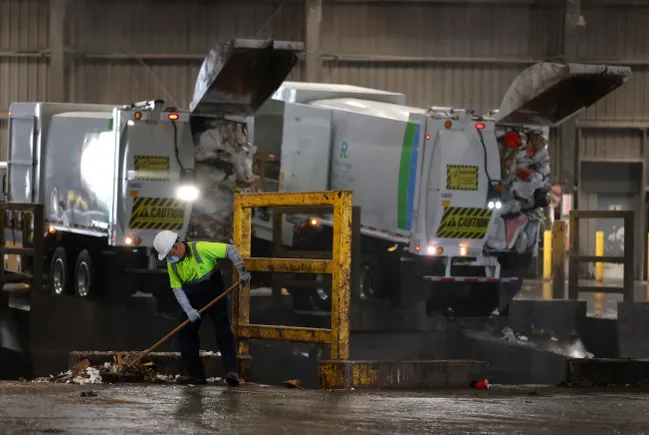
 Workers at Recology's San Francisco MRF
Image source: Justin Sullivan via Getty Images
Local action
Amid these broader questions about potential legal consequences, Recology's operations in San Francisco remain largely unchanged, as its monopoly on most of the city's collection services dates back to franchise permits under a 1932 ordinance. Many parties expect any large-scale change to be a difficult political fight, but have not ruled out the possibility.
Meanwhile, Recology has been trying to refresh its image, focusing on employee shareholders. This spring, it launched an advertising campaign highlighting workers saying "thank you" to local residents in multiple languages and saying "let's continue to make a difference together." Throughout the corruption exposure, sources and local reports have repeatedly said many residents still appreciate Recology's frontline workers and do not equate them with the legal issues.
"The fact is, Recology isn't necessarily unpopular in San Francisco. People are satisfied with the service," said John Bouchard, secretary-treasurer of Teamsters Local 350. "Right now, it's business as usual, and hopefully for my members, it stays that way."
Recology also initiated the required rate refund process in July, with reports that checks are being mailed to current and former customers, some in amounts of hundreds of dollars. In August, the City Attorney's office sent a memo to all elected officials, department heads, and city commissions and committee members, reminding them of new ethics provisions applicable to Recology for four years. Under the city settlement, Recology employees may not give gifts of any value to city officials or make payments of any value at city officials' request.
A ballot initiative that could overturn the company's franchise arrangement—which critics have attempted unsuccessfully in the past—has not materialized. Former judge and outspoken critic of the franchise monopoly Quentin Kopp recently said efforts to gather support for a new vote have not yet taken shape.
San Francisco Board of Supervisors member Aaron Peskin announced plans in March to form a working group, telling Mission Local it would explore "whether we should seek to acquire Recology's assets, including its transfer stations and dedicated collection fleet, with the aim of municipalizing garbage collection." The entity was later renamed the Refuse Working Group and held one meeting on May 21, presenting alternatives including "competitive bidding" and "in-house" municipalization.
Although the initial timeline included multiple summer meetings and a final report in November, the group has not met since. Peskin's chief of staff said there are no further updates on next steps. Recology declined to answer its views on the working group.
Another potential area of change, which some believe falls outside Recology's franchise permits, is the awarding of ancillary contracts, such as the one for collecting materials from government buildings. After the Giusti news broke last fall, the Board of Supervisors declined to award a new five-year contract to Recology for a service it had provided for years.
The city's Contract Management Office ultimately changed the terms to a six-month contract lasting through June, requiring no board action. A spokesperson recently confirmed the contract was later extended to November 30, with no further decision made.
Earlier this year, regional competitors Waste Management and Republic Services publicly expressed interest in bidding on the contract and discussing further cooperation with the city. Both companies have since remained silent on the matter, with Waste Management declining to comment.
While some believe momentum for further changes to Recology's franchise status could come from working group recommendations, many others hope the 100-plus-year-old company and its employee shareholders will maintain their dominant position in the local market.
"If they worked for any other company, they would lose employee ownership, which is a significant benefit for our members," Bouchard said, who attended the initial working group meeting and believes municipalization is not a good option for his members. "As the local union representing them, our top priority is ensuring they don't lose anything in the process."