
Three Regions in Southern California Accelerate Organic Waste Recycling Programs
With the full implementation of California SB 1383, various areas in Southern California are accelerating organic waste recycling. Los Angeles plans to expand residential collection in phases, San Diego faces funding difficulties due to historical ordinance restrictions, and San Bernardino County is exploring viable solutions in remote areas. These three cases highlight the different challenges posed by scale, cost, and geographic differences.
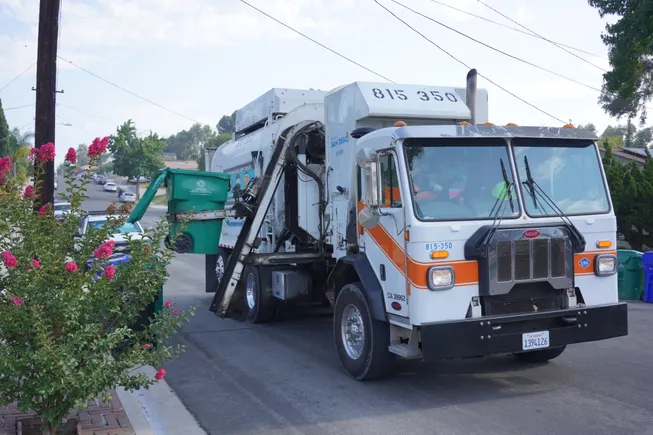
Editor's Note: This article is the fourth in a series exploring the market impact of California's comprehensive organic waste reduction law (SB 1383).
As California local governments gradually expand organic waste collection and meet the various new requirements of SB 1383, each jurisdiction is addressing unique logistical and financial considerations.
Although many jurisdictions have taken the first step by adopting or updating local ordinances to comply with the law, their collection readiness varies significantly. In Northern California, especially the Bay Area, some jurisdictions have been collecting food scraps and yard waste for years. Some areas in Southern California, however, are seen as facing a more difficult task—requiring large-scale expansion of organic waste collection and processing infrastructure, partly due to the evolution of landfills in the region: more landfills are publicly owned, which lowers tipping fees but also reduces incentives to reduce landfilling. Los Angeles, San Diego, and other Southern California jurisdictions are currently working intensively to launch large-scale programs in the coming months.
From sparsely populated desert areas to some of the state's largest cities, local officials from three regions provided a snapshot of their progress over the past year.

Los Angeles: Phased Rollout of Large-Scale Collection
As the state's largest city, Los Angeles may be one of the most prominent cases of large-scale organic waste collection rollout, with its municipal team needing to serve more than 750,000 residential customers.
In May 2019, the Los Angeles Sanitation and Environment (LASAN) launched a pilot program for 18,000 households, co-collecting food scraps and yard waste and providing kitchen pails to assist with sorting. Although the pilot continued during the pandemic, with household participation rates stable at least 30%, further expansion was put on hold. Now, the agency will expand the program to a total of 40,000 households in July, with the remainder completed by January.
Alex Helou, assistant director of solid resources program development at LASAN, noted that this is just one of several options for residents to manage food scraps. "You can put it in the green bin, put it down the sink, or take it to a farmers market," he said. "We're trying to make everything as convenient as possible."
In addition to expanding the green bin option, the agency supports home composting, as about 540,000 sites served by LASAN are single-family homes. "A lot of people do backyard composting," Helou said.
LASAN has also provided some residents with new sink garbage disposals, with 24/7 city-funded plumbing support for the first year. Due to cost and participation rate differences, the program did not receive further expansion funding. The city also plans to expand drop-off sites at farmers markets in the coming months, partnering with nonprofit composting organizations, potentially offering dozens of free locations.
For customers within the recycLA franchise system (including commercial accounts and large multi-family buildings), the full rollout of organic waste collection was delayed during the pandemic and is now back on track. Helou noted that recycLA service providers have contractual incentives to demonstrate waste reduction progress ahead of the 2025 target. Other growth areas include Los Angeles International Airport and City Hall, as foot traffic rebounds in both locations following the initial pandemic disruptions.
Helou said Los Angeles is in a slightly better position than some jurisdictions because its green bins have already accepted various organic wastes (mixed with yard waste), but adding food scraps at scale remains complex. An existing agreement with Recology's Bloss Valley organic waste processing facility covers composting needs for the next phase in July, but after that the city will need to find another processing site, and it is currently evaluating responses to a recent solicitation.
Helou said the city is not considering mixed waste collection or processing and explicitly prohibits it in recycLA, "because we're pursuing the highest and best use."
Overall, he believes the best measure of the city's organics recycling program success is whether it can significantly reduce landfill disposal to align with upcoming zero waste goals, and this shift could be substantial.
"We need recyclers that can handle up to 2,700 tons of organics per day," Helou said, based on estimates of an additional 1,000 tons per day expected after the full collection rollout.
The expansion of processing infrastructure is not just a challenge for the city. Los Angeles County may also need to significantly expand capacity; one official estimated that there could be enough capacity in the future to support up to 12 new anaerobic digestion projects. Another example is neighboring Long Beach, which recently said it is still looking for sufficient processing capacity because a potential site has extremely high demand.

San Diego: The Dual Challenge of Funding and Ordinance
California's second-largest city faces a similar need for rapid expansion. Currently, about two-thirds of the city's households have yard waste collection service, but not food scraps. Commercial and multi-family residential service is covered by franchise agreements with local haulers. City residential service is currently provided biweekly, with many customers providing their own bins or bundling materials. This situation is about to change—and at significant cost.
"The significant costs of SB 1383 include: we have to expand citywide, provide containers for all customers, and add food scrap collection," said Ken Prue, deputy director of the city's Environmental Services Department, noting another complexity: "Because we don't have a rate, we can't pass on any costs."
Due to a 1919 People's Ordinance, San Diego cannot directly charge residents for this service, unlike the vast majority of jurisdictions in the state. Efforts to change the ordinance have made progress; a ballot initiative to repeal the free garbage service could go before voters in November, but the estimated $30 million cost of new bins needs to be addressed in the meantime.
Prue said the city believes source-separated three-bin collection is the only realistic option. Materials will be processed at the city's composting facility at its Miramar landfill. The site uses an aerated static pile system to process commercial materials and has additional capacity to receive residential materials. Despite the considerable costs, city officials say they look forward to further reducing methane emissions from the landfill and responding to local demand.
"This aligns with our goals—the zero waste plan and the climate action plan—and it's something many residents have long requested and advocated for," Prue said. "Before, we couldn't find funding; now with the state mandate, we have to do it."
San Bernardino County: Exploring Under Geographic and Cost Constraints

Desert and mountain communities in San Bernardino County have never previously collected yard waste or food scraps from residents, and the arid climate adds to the difficulty.
John Davis, administrator of the Mojave Desert and Mountain Recycling Authority, said green waste accounts for less than 10% of the waste stream in member jurisdictions. The authority's geographic scope—covering an area nearly the size of Connecticut—combined with low population density and limited budgets in many areas, means collecting such materials is not cost-effective. To date, at least two local government members of the joint powers authority have received exemptions from CalRecycle: one due to high altitude, where adding food scrap bins attracts bears into residential areas; another due to sparse population.
Some members of the authority currently send commercial organic waste to a composting facility operated by Burrtec Waste Industries in Victorville, which provides hauling services for many member jurisdictions, but not all jurisdictions can logistically use the site. Davis said members have evaluated various options, but many ultimately proved too costly.
Even with lower volumes of material coming into a facility, "capital costs remain essentially the same," Davis said.
Last year, the authority considered some form of mixed waste processing for all materials except recyclables. Initial testing showed that the state's 50% recovery rate required for "high diversion facilities" using mixed waste systems could be achieved, and even higher recovery rates seemed feasible. However, the idea was ultimately abandoned due to the high cost of transporting materials over long distances between processing facilities, composting sites, and landfills. The authority also considered building its own mixed waste processing line, but ruled it out after evaluating equipment delays and steel costs.
"Maybe it could work, but in the end the numbers didn't add up," Davis said. He said members are now focused on finalizing new rates, adapting to the overall requirements of SB 1383, and—for jurisdictions that already have processing destinations—launching organic waste collection in the coming months. Barstow will be the first local city to take this step, partnering with Burrtec to start a new bin distribution program in July.
"Cities close to composting facilities are moving quickly; others need to find processing capacity."
Stay tuned for Part Five, which will focus on the lessons learned and limitations of years of organics recycling in the Bay Area.